
继承者们
4,220-year-old rock art in SW China’s Yunnan reveals early cultural links with Southeast Asia_我的网站

一 | The Indian film fraternity is mourning the loss of Dharmendra, one of Hindi cinema’s most beloved and enduring icons, whose passing at the age of 89 has sparked an outpouring of emotion across industries and generations. Known for his irresistible screen presence, gentle humour and unmistakable warmth, Dharmendra was a star whose influence travelled far beyond the borders of Bollywood. His colleagues and admirers from Tamil and Malayalam cinema, including Kamal Haasan, Rajinikanth, Mammootty and Mohanlal, joined the rest of the country in remembering a man whose artistry and humanity shaped Indian film culture for more than six decades.Kamal Haasan’s heartfelt farewell to a dear friendVeteran actor Kamal Haasan took to social media to remember his friend and colleague Dharmendra, who passed away in Mumbai at the age of 89, only weeks before his 90th birthday.Posting on his X handle, Kamal wrote, “Deeply saddened by the passing of my dear friend and legendary actor Dharmendra ji. Dharam ji’s charm, humility and strength of spirit were as real off screen as on it. Indian cinema has lost one of its kindest icons. My heartfelt condolences to his family and admirers.” Deeply saddened by the passing of my dear friend and legendary actor Dharmendra ji. Dharam Ji’s charm, humility and strength of spirit were as real off-screen as on it. Indian cinema has lost one of its kindest icons. My heartfelt condolences to his family and admirers. pic.twitter.com/I9CgBmlCzl — Kamal Haasan (@ikamalhaasan) November 24, 2025 Kamal and Dharmendra shared screen space in the 1984 Hindi film Raaj Tilak, directed by Rajkumar Kohli. The epic ensemble also featured Sunil Dutt and Hema Malini, and remains a reminder of a time when talents from different film industries came together for grand, larger than life entertainers. Their bond, however, extended far beyond a single film, built on mutual respect and affection.Rajinikanth, Mammootty and Mohanlal remember a gentle giantTributes also poured in from other South Indian icons whose paths crossed with the Hindi superstar over the decades.Superstar Rajinikanth, who acted with Dharmendra in films like Insaaf Kaun Kharega in 1984 and Farishtay in 1991, shared an emotional message on X. He wrote, “Farewell, my friend. I will always remember your golden heart and the moments we shared. Rest in peace, Dharam ji. My deepest condolences to his family.”Dharmendra had spoken with equal warmth about Rajinikanth. While promoting his film Yamla Pagla Deewana in Chennai, he recalled first meeting Rajinikanth and his wife Latha in Ooty. He described Rajinikanth as a younger brother and said that his love for the superstar and his family had only grown since that first meeting. In 2021, Dharmendra even shared a scene from Insaaf Kaun Kharega on X and captioned it, “Rajini a darling friend a great actor,” a line that now reads like a fond farewell in retrospect. Farewell, my friend. I will always remember your golden heart and the moments we shared. Rest in peace, Dharam ji. My deepest condolences to his family. — Rajinikanth (@rajinikanth) November 24, 2025 Malayalam megastar Mammootty also paid tribute to Dharmendra and underlined how deep the veteran’s impact ran across generations. His message read, “A true icon has left us. Dharam ji’s legacy will continue to inspire every generation. Heartfelt condolences and prayers.”Mohanlal, another towering figure in Malayalam cinema, called Dharmendra’s passing the end of a cinematic chapter. He wrote, “The passing of Dharmendra ji marks the end of a cinematic era. A legend whose warmth and artistry will live on forever. My deepest condolences to his family and loved ones. Om Shanti.”These messages from Tamil and Malayalam superstars speak to Dharmendra’s rare ability to transcend regional boundaries. For artists who primarily built their careers in South Indian languages to feel such a personal sense of loss for a Hindi cinema icon shows how genuinely he connected with his peers. He was a colleague, an elder and a friend who made everyone around him feel seen and valued.A family man and an enduring legacyDharmendra is survived by his first wife Prakash Kaur and his second wife, actor and politician Hema Malini. His sons Sunny Deol and Bobby Deol, daughters Esha and Ahaana Deol, along with Ajeita and Vijeita from his first marriage, carry forward both his personal and professional legacy.For audiences, he remains the original He Man of Hindi cinema, the romantic hero with soulful eyes and the action star with an easy grin. For his colleagues in Tamil and Malayalam cinema, he leaves behind memories of a kind, grounded man who treated superstars and newcomers alike with warmth and generosity.As Indian cinema collectively mourns his passing, the tributes from Kamal Haasan, Rajinikanth, Mammootty and Mohanlal remind us that true stardom is not confined to a single language or industry. It lives in the lives an artist touches, both on screen and off it.Also Read: Moushumi Chatterjee: Dharmendra had a childlike soul, his smile was divine - Exclusive。
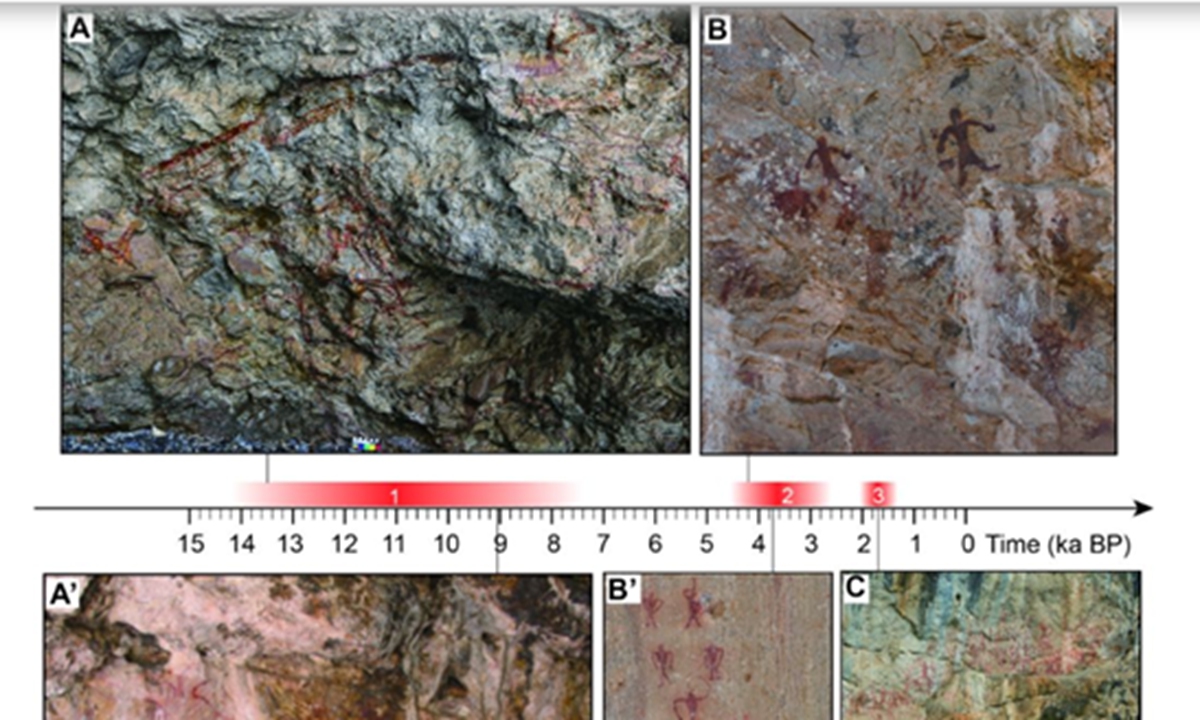
Chinese researchers have obtained the first absolute dates for rock paintings at the Mangguan rock art site in Southwest China's Yunnan Province, pushing the known history of rock art created by prehistoric settled communities in the region back to about 4,220 years ago. The paintings also suggest cultural interactions more than 4,000 years ago between Southwest China and civilizations along the Yellow and Yangtze rivers, as well as possible exchanges with neighboring parts of Southeast Asia, including present-day Myanmar, Thailand and Vietnam, a member of the research team told the Global Times.
The Yunnan Provincial Institute of Cultural Relics and Archaeology, in collaboration with Nanjing Normal University and other institutions, have recently made a significant archaeological breakthrough. Through systematic surveys and uranium-thorium (U-Th) dating at the Mangguan site in Gengma county, the research team obtained the first absolute dates for the site's rock paintings, tracing rock art created by prehistoric settled communities back to around 4,220 years ago.
The findings were recently published in the international journal Journal of Archaeological Science: Reports.
The Mangguan rock paintings represent one of the best-preserved prehistoric rock art sites in Yunnan. The research team presented high precision U Th dating of carbonate accretions that stratigraphically overlie the painted motifs at the Mangguan site, according to the paper published in the journal.
The dating results show that carbonate deposits overlying a human figure yielded a corrected age of 4,240 ± 19 years before present, confirming that ancient people living in the region had already produced mature figurative art at least 4,220 years ago, Wu Yun, first author of the paper and an associate researcher at the Yunnan Provincial Institute of Cultural Relics and Archaeology, was cited by the Xinhua News Agency report as saying.
Dating results from 11 samples taken from different motifs clustered between about 3,907 and 3,056 years ago. By comparison, the Cangyuan cliff paintings had previously been dated to roughly 3,800 to 2,700 years ago. The Mangguan paintings are therefore significantly older, filling an important chronological gap in the region's artistic record before the Cangyuan phase.
Shao Qingfeng, corresponding author of the paper and a professor at the School of Geography at Nanjing Normal University, told the Global Times that previous estimates dated the Mangguan rock paintings to a little over 3,000 years ago based mainly on imagery and comparisons with similar regional sites. Using microsamples of secondary carbonate deposits overlying the paintings, researchers have now obtained a precise minimum age of about 4,220 years before present without damaging the rock art.
The findings and the establishment of this chronological framework not only strengthen the archaeological foundation for studying rock art in Southwest China, but also provide a direct reference for rock art sites across Southeast Asia that have yet to undergo systematic dating, Shao said.
The findings may also challenge long-held perceptions of Southwest China around 4,200 years ago - roughly the era of the Xia Dynasty (c.2070 BC-C.1600 BC) - and help fill a key gap in understanding the pluralistic yet integrated development of Chinese civilization.
Shao said that while academic research has traditionally focused on the Yellow River and Yangtze River basins as cradles of early Chinese civilization, sites such as Mangguan and Cangyuan show that stable and culturally active communities also thrived in mountainous Southwest China. The newly established rock-art chronology brings an artistic dimension to the broader narrative of China's enduring cultural development.
Moreover, stylistic similarities suggest that Southwest China maintained exchanges with the Yellow River and Yangtze River regions and with early societies in Southeast Asia, providing material evidence of cross-regional interaction more than 4,000 years ago.
。

二 |
Current article:http://jwfauha.senbatuqiuzhuanlanrilao.sbs/list_zdx/rej21.html
Published on:16:25:55
评论
-
关于我们 | 我的网站 版权所有
Copyright ? 2019 我的网站 All Rights Reserved